Are you a digital marketing pro constantly seeking ways to amplify your website’s visibility, boost user engagement, and skyrocket organic traffic? Or are you a local business owner in Gloucester or Cheltenham trying to get some quick wins in SEO? If so, it’s time to unlock the power of snippets, particularly Google Featured Snippets. In this all-encompassing guide, we’ll spill the beans on how to conquer Google Featured Snippets—the game-changing SEO and content marketing tactic you need to elevate your online presence and authority.
A Quick Rundown on Google Featured Snippets
Demystifying Google Featured Snippets
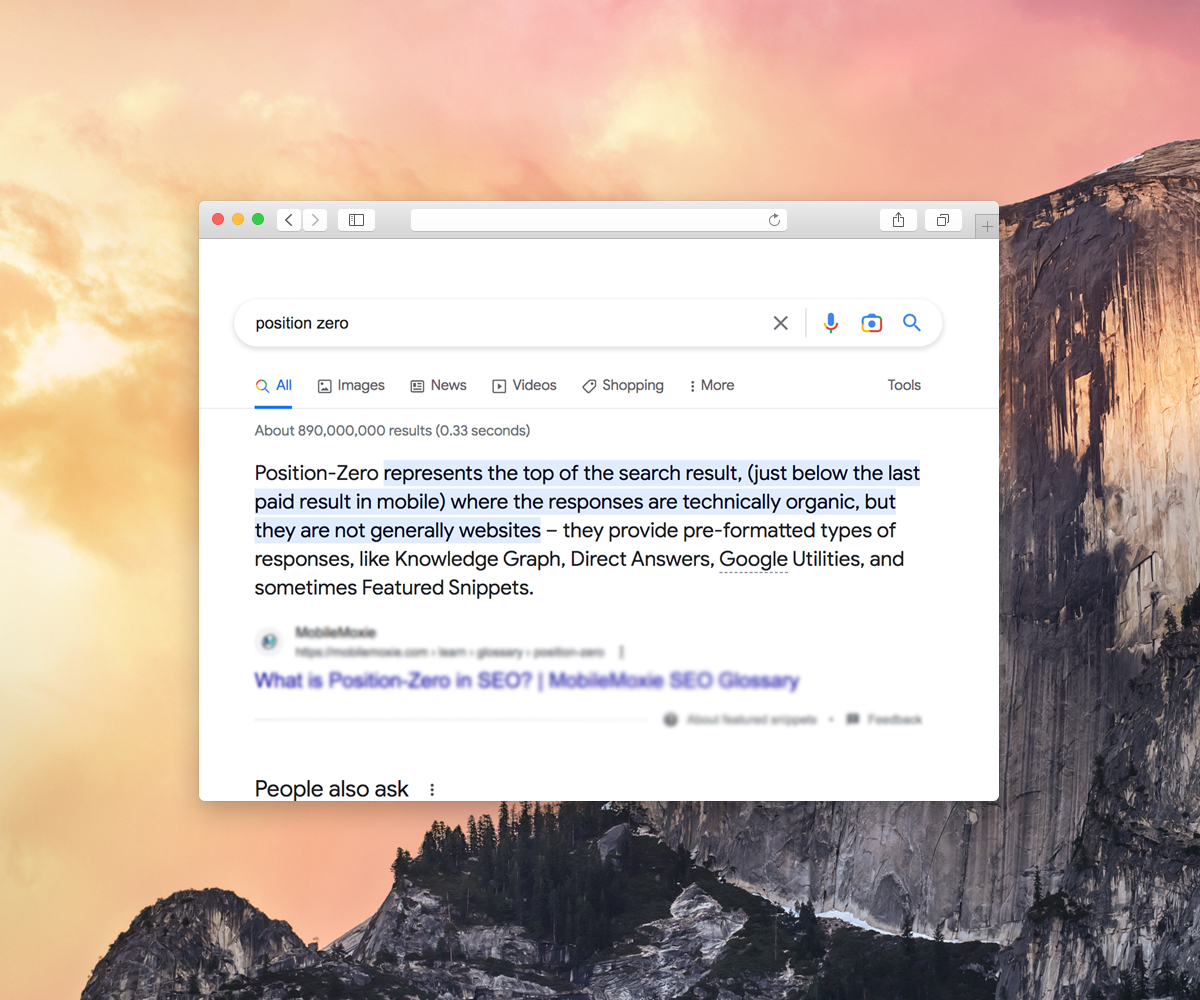
 Google Featured Snippets, aka “position zero,” are prime search results nestled in an exclusive box atop the search engine results page (SERP), just beneath the ads. They furnish a succinct response to a user’s inquiry, extracted from a webpage, and showcase the page’s title, URL, and a snippet of pertinent text or image.
Featured Snippets come in diverse forms, such as:
- Paragraph snippets: Text blocks delivering direct answers to users’ questions.
- List snippets: Numbered or bulleted lists outlining a series of steps or items related to the query.
- Table snippets: Tables displaying organised data, like pricing, comparison, or statistical details.
- Video snippets: Video thumbnails and timestamps spotlighting the video segment that answers the query.
Why Google Featured Snippets Matter for SEO
 Google Featured Snippets aren’t merely a pleasant bonus for your website’s search results—they’re a mighty SEO weapon that can profoundly influence your site’s visibility and click-through rate (CTR). Here’s why they’re indispensable for SEO:
- Heightened visibility: Featured Snippets grab the sought-after “position zero,” pushing organic search results down the page. This increased exposure can lead to higher click-through rates and more organic traffic flowing to your site.
- Boosted credibility: Securing a featured snippet signals that Google deems your content a trustworthy and authoritative source, enhancing your website’s credibility and reliability in users’ eyes.
- Voice search optimisation: As voice search gains traction, owning a featured snippet can help your content become the go-to answer for voice-activated assistants like Google Assistant, Siri, and Alexa.
- Competitive edge: Landing a featured snippet can help you outshine your competitors and draw more users to your site.
A Featured Snippet gets approximately 8% of all clicks according to Search Engine Land
Crafting Top-Notch, Snippet-Worthy Content
Optimising Your Content for Featured Snippets
To up your odds of scoring a Google Featured Snippet, it’s vital to optimise your content with these best practices:
- Directly address users’ queries: Generate content that offers clear, concise answers to prevalent questions in your niche. Use keyword research tools to pinpoint popular queries and ensure your content tackles these questions effectively.
- Leverage long-tail keywords: Long-tail keywords are more precise and less competitive than short-tail keywords, making them ideal for targeting featured snippets. Incorporate these keywords into your content and headings to enhance your chances of being featured.
- Produce in-depth, authoritative content: Google favours content that’s comprehensive, well-researched, and authoritative. Strive to create high-quality content that adds value to your audience and distinguishes you as an expert in your field.
- Regularly update your content: Keep your content fresh and current by routinely revising and updating it. This can help retain your featured snippet status and ensure your information remains relevant and accurate.
Formatting Your Content for Google Featured Snippets
Proper content formatting can significantly impact your likelihood of earning a featured snippet. Keep these formatting tips in mind:
Utilise headings and subheadings: Divide your content into easily digestible sections using headings and subheadings. This not only enhances readability but also helps Google grasp your content’s structure and pinpoint relevant snippets.
- Craft lists and tables: For list and table snippets, format your information using numbered or bulleted lists or create tables to display structured data.
- Incorporate images and videos: Including pertinent images and videos can enrich your content and boost your chances of securing a video or image-based snippet.
- Implement Schema markup: Schema markup is a type of structured data that aids search engines in better understanding your content. Applying schema markup can improve your odds of earning a featured snippet, particularly for more intricate content types, like recipes or events.
8 Step Plan for Google Featured Snippets Success:
 Proper content formatting can significantly impact your likelihood of earning a featured snippet. We have refined our approach to optimising content for Google’s featured snippets, developing a set of 8 guidelines to boost the likelihood of securing that coveted position. Learn more about each guideline below:
1. Incorporate a ‘What is’ heading
Begin your featured snippet optimisation by adding a “What is [keyword]” heading tag to your content. This signals to Google that the following text may be ideal for a featured snippet.
Many examples of pages with featured snippets employ this heading format, and we’ve seen positive results when implementing this strategy for our clients.
Ideally, place this heading as close to the top of your content as possible. If writing a blog post, it’s generally best to add it right below the introductory paragraph. This allows for a natural flow while ensuring the heading is near the top of the page.
2. Employ the ‘is’ sentence structure
When optimising for the featured snippet, make sure to include an “is” statement.
The first sentence should begin with the structure: “[Keyword] is…”
Our analysis of pages with featured snippets consistently reveals that “is” statements are utilised within the text.
In our experience, this content structure acts as a “triggering phrase” that allows Google to easily find relevant text for the featured snippet.
To increase your chances of obtaining the featured snippet position, ensure that your first sentence follows this format. By using an “is” statement, you should see a higher percentage of your optimisations resulting in featured snippet wins.
3. Thoroughly describe the topic in 2-3 sentences
This is arguably the most crucial guideline to follow.
Featured snippets should provide users with as much information about the topic as quickly as possible.
This means the content you’re optimising must try to explain the topic as comprehensively as possible in two to three sentences or according to SEMRush, on average a Featured Snippet is between 40-60 words long. For this guideline, conciseness is key.
Here are some general principles we try to follow when attempting to succinctly define featured snippets:
- The first sentence should define the topic.
- The second and third sentences should describe 2-3 essential facts about the topic.
- Avoid using extraneous phrasing in your definition.
4. Align with the featured snippet format
As explained earlier, the different types of featured snippets include:
- Paragraphs (most common).
- Bulleted and numbered lists.
- Tables (least common).
This guideline is straightforward. Whatever featured snippet type you see on the SERP, replicate that format in your content.
For instance, if you see a paragraph featured snippet for the term you want to optimise, you need to find a place to add or adjust two to three sentences of text.
However, if a bulleted list appears, you’ll need to add a similar list to your page’s content.
5. Refrain from using your brand name in featured snippet text
This is a common mistake we see.
A company may follow rules 1-4 correctly but include language that renders the result ineligible for the featured snippet. Brand names are one example of such language.
Remember that featured snippets fuel voice search. Devices like Google Home will directly read what’s in the featured snippet to users. This means that the content needs to make complete sense in this context.
For example, say FreshMart was trying to optimise for the featured snippet “health benefits of kale” and used the following sentence:
“Kale from FreshMart has numerous health benefits, as it is an excellent source of vitamin K, vitamin C, and iron.”
When read by a voice assistant, this might be confusing as the searcher was looking for general benefits that apply to all kale – not just the ones sold by FreshMart.
Replacing the brand name with general language will give the content a higher chance of receiving a featured snippet.
The ideal optimisation could look something like this:
“Kale has numerous health benefits, as it is an excellent source of vitamin K, vitamin C, and iron.”
6. Avoid using first-person language
Similar to the previous guideline, using first-person language can be problematic due to the implications of voice search.
In the above example, let’s say the on-page text optimised for the featured snippet read:
“Our kale has many health benefits. We have kale that is an excellent source of vitamin K, vitamin C, and iron.”
Again, imagine if this sentence was read by a voice assistant. The user might wonder:
- Who is the “we” being referenced?
- Does this information only apply to their product?
- This sounds like the information might be specific to a type of kale and might not apply to the food in general.
Limiting this type of phrasing may also help you improve your chances of receiving a featured snippet.
7. Scale featured snippets when possible
We’ve observed interesting behavior over the years with bulleted list featured snippets.
For example, a search for the term “best retail franchises” yields the following featured snippet below.
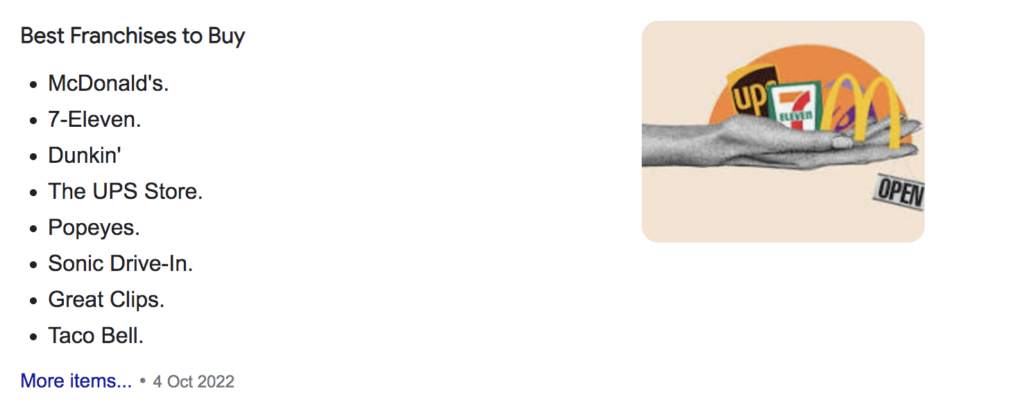 However, when examining the page, there is no specific bulleted list. Instead, the page is set up as a standard e-commerce category page.
What Google appears to be pulling the featured snippets from is actually the individual product listings within the category page, and the selected text all appears to be formatted as H3. We’ve recommended adjusting the HTML on category pages from standard paragraph tags to H2 or H3 tags for some clients. This might send stronger signals that could scale featured snippet optimisation globally.
Take the time to review where Google is pulling your competitors’ featured snippets from. If you’re seeing common HTML elements, consider adjusting your global templates to give your content the best chance of triggering the featured snippet.
8. Focus on opportunities where you rank in the top 5
Previous studies have shown that ranking position matters for claiming a featured snippet. Simply put, the higher you rank, the better your chance of claiming one.
An Ahrefs study showed that results ranking in the first position had a 30.9% chance of receiving a featured snippet. Positions 2 and 3 had a 23.5% and 15.9% chance, respectively.
While this data might be different now due to deduplication, it still has clear takeaways for SEOs.
The higher your site ranks in the “standard” results, the better the chance of generating a featured snippet.
When prioritising, look for keywords where you already rank within the top 5 results.
By following these strategies, you can increase your chances of securing featured snippets for your content. Remember to focus on clarity, conciseness, and relevance while avoiding brand-specific and first-person language. With persistence and fine-tuning, you’ll be on your way to optimising your content for Google’s coveted featured snippets.
Keeping Tabs on Your Google Featured Snippets
Measuring Your Featured Snippet Performance
To gauge the success of your featured snippet strategy, it’s crucial to monitor and track your performance. Some handy tools and techniques for evaluating your featured snippet performance include:
- Google Search Console: Utilise the performance report in Google Search Console to track your website’s clicks, impressions, CTR, and average position. This data can help you identify which pages and keywords are driving featured snippet traffic.
- Google Analytics: Examine your organic traffic, engagement metrics, and conversion rates in Google Analytics to determine the overall impact of your featured snippets on your website’s performance.
- SERP monitoring tools: Tools like SEMrush, Ahrefs, and Moz can help you track your featured snippet rankings and spot new opportunities for targeting snippets.
- Manual monitoring: Regularly conduct manual searches for your target keywords and observe which featured snippets you’ve earned, as well as any changes or fluctuations in your snippet rankings.
Adjusting Your Strategy for Future Wins
As you monitor and analyse your featured snippet performance, use this data to inform and adapt your strategy. Continuously optimise your content, identify new opportunities, and learn from your successes and failures to fine-tune your approach and achieve long-term success with Google Featured Snippets.
Final Thoughts on Mastering Google Featured Snippets
Becoming a snippet maestro can be an invaluable tool in your Search engine optimisation toolkit, helping you attain increased visibility, credibility, and organic traffic. By crafting top-notch, snippet-worthy content, optimising your content and formatting, and diligently monitoring your performance, you can unleash the full potential of Google Featured Snippets and revolutionise your online presence.
As you set off on your quest to master the art of snippets, bear in mind that scoring a featured snippet isn’t guaranteed, and the competition can be intense. Nevertheless, with persistence, dedication, and a data-driven approach, you can enhance your chances of success and make a lasting impact on your website’s SEO and content marketing endeavours.
Digital Marketing Agency in Gloucester and Cheltenham
Softdata is a leading digital agency and AI Services provider based in Gloucester and Cheltenham.About us: Softdata is a premier digital software agency and digital marketing provider, based in Gloucester and Cheltenham. We offer a range of digital services including web design, bespoke software development, SEO, Paid advertising, conversion rate optimisation, web hosting, and AI consultancy services. Our team is dedicated to providing the best solutions tailored to the unique needs of our clients.
If you would like to discuss your needs with a Digital Specialist, we offer a Free Initial Consultation without cost or commitment. Meetings can be held at our offices, via video conference, or by telephone. Our telephone number is 01452 502 508.
Softdata is located at: Softdata Internet Limited, 80 Westgate Street, Gloucester, GL1 2NZ.